Croesus and the First Coins
Rich as Croesus: the last king of Lydia, the first gold coins, and an oracle he misread.
Croesus ruled Lydia from Sardis in the mid 6th century BC, until the Persian king Cyrus took the city around 547 BC. Lydia is credited with the first coins, and Croesus with the first coins of pure gold and pure silver; his wealth became a proverb.
- Who
- The last king of Lydia, 6th century BC
- First
- Lydia is credited with the first coins
- Capital
- Sardis, near today's Salihli, Manisa
- Fell
- Sardis taken by Cyrus of Persia, about 547 BC
The first coins
Herodotus says the Lydians were the first people to strike coins of gold and silver. The earliest were small lumps of electrum, the gold and silver alloy found in Lydia's rivers, stamped with a lion's head in the late 7th century BC.
Sardis then learned to part the two metals. Excavators found the refinery beside the Pactolus, where gold dust was heated with salt in clay pots to draw out the silver. Coins of pure gold and of pure silver followed, later called croeseids after the king; some may have been struck after the Persians took the city.
The oracle
Croesus sent Delphi gifts on a scale no one forgot, among them a lion of refined gold standing on 117 gold ingots. Before going to war with Persia he asked the oracle what would happen. The answer: if he attacked, he would destroy a great empire. He did, and the empire he destroyed was his own.
On the pyre
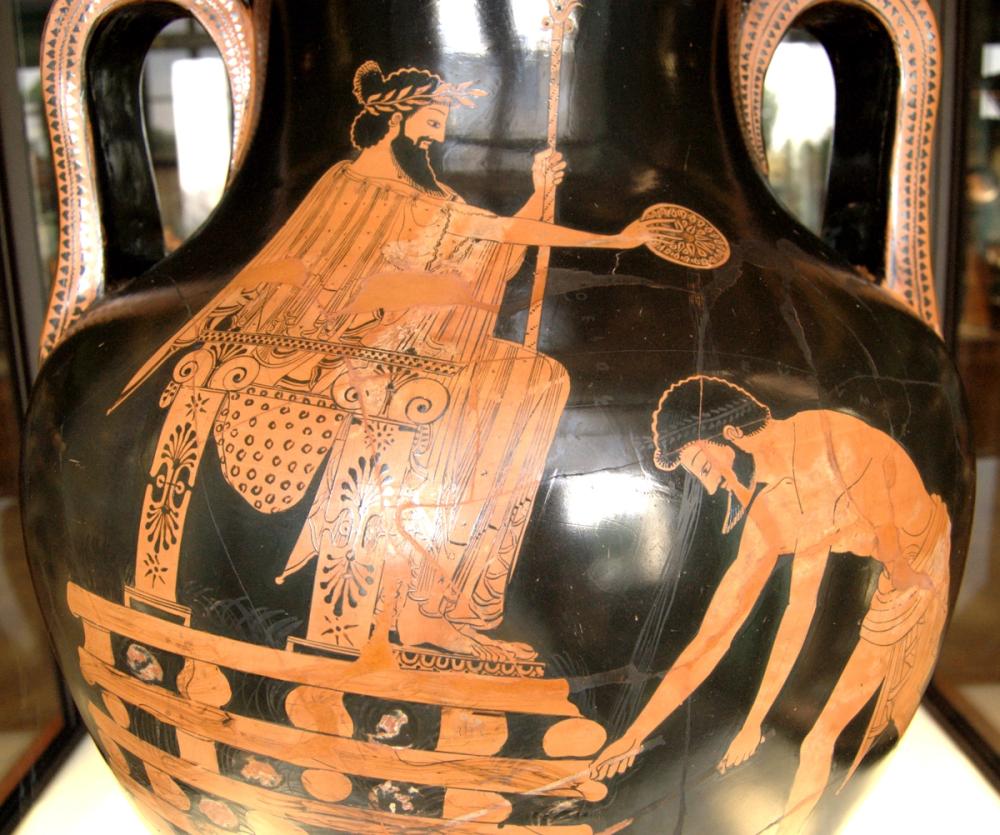
Herodotus tells that Cyrus had Croesus placed on a pyre. Croesus called out the name of Solon, the Athenian who had warned him that no one should be called happy before the end of his life, and Apollo sent rain to put out the fire. A painter in Athens showed a calmer version around 500 BC: Croesus enthroned on the pyre, pouring an offering, while a servant lights the wood.
The treasure that came back
In Turkish, Lydian gold goes by another name: the Karun Treasure. Hundreds of objects dug from Lydian burial mounds near Uşak in the 1960s were bought by the Metropolitan Museum in New York. After a six-year court case they were returned to Türkiye in 1993 and are shown in Uşak. The Karun of the proverb "rich as Karun" is in fact Qarun from the Quran, but the name stuck to Croesus's gold.
Where it leads
 Unknown author · Wikimedia Commons (CC BY-SA 3.0)
 User:China_Crisis · Wikimedia Commons (CC BY-SA 2.5)
 Diego Velázquez · Wikimedia Commons (Public domain)
Sources
- Herodotus, Histories 1.26–94 (Croesus, the oracle, the pyre, Lydian coinage)
- John H. Kroll, "The Coins of Sardis", in The Lydians and Their World (2010)
- Andrew Ramage and Paul Craddock, King Croesus' Gold: Excavations at Sardis and the History of Gold Refining (2000)
- Croesus on the pyre, Attic red-figure amphora attributed to Myson, Louvre G 197
- Karun Treasure (Wikipedia)
