Midas
The king whose touch turned everything to gold was a real ruler of Phrygia.
Midas was a real king of Phrygia in the late 8th century BC, ruling from Gordion near today's Polatlı. The Greeks remembered him through two myths, the golden touch and the donkey's ears, and both are about a king who wanted the wrong thing.
- Who
- A king of Phrygia; in myth, all he touched turned to gold
- Capital
- Gordion, near today's Polatlı, Ankara
- See it
- Gordion's great burial mound, popularly called the Tomb of Midas
- When
- Late 8th century BC
The real king
Assyrian records from the reign of Sargon II name a king called Mita of Mushki, who dealt with Assyria in the 710s BC; historians identify him with Midas. Herodotus says Midas was the first foreigner to send a gift to Apollo at Delphi: the throne on which he sat to give judgement.
Later Greek writers said his kingdom fell to the Cimmerians, horsemen from north of the Black Sea, early in the 7th century BC, and Strabo has Midas die by drinking bull's blood.
The golden touch
In Ovid's Metamorphoses, Midas takes in Silenus, the drunken old companion of Dionysus, and returns him safely. Offered any wish, he asks that whatever he touches turn to gold. Bread hardens in his hand and wine turns to metal in his mouth. Dionysus tells him to wash in the river Pactolus near Sardis; the gift flows out of him into the water, and that, the story says, is why the river carried gold.
The donkey's ears
In a second story Midas judges a music contest and prefers Pan's pipes to Apollo's lyre. Apollo gives him donkey's ears. He hides them under a cap, but his barber cannot keep the secret: he whispers it into a hole in the ground, reeds grow there, and the reeds repeat it whenever the wind blows.
What you can see
Gordion's great burial mound, Tumulus MM, is still called the Tomb of Midas. Tree rings date its timbers to about 740 BC, too early for Midas, so it most likely belongs to a ruler before him. Inside, excavators found the Phrygians' craft: bronze cauldrons and bowls, inlaid wooden furniture, and dozens of fibulae, the bronze safety-pin brooches Phrygia was known for.
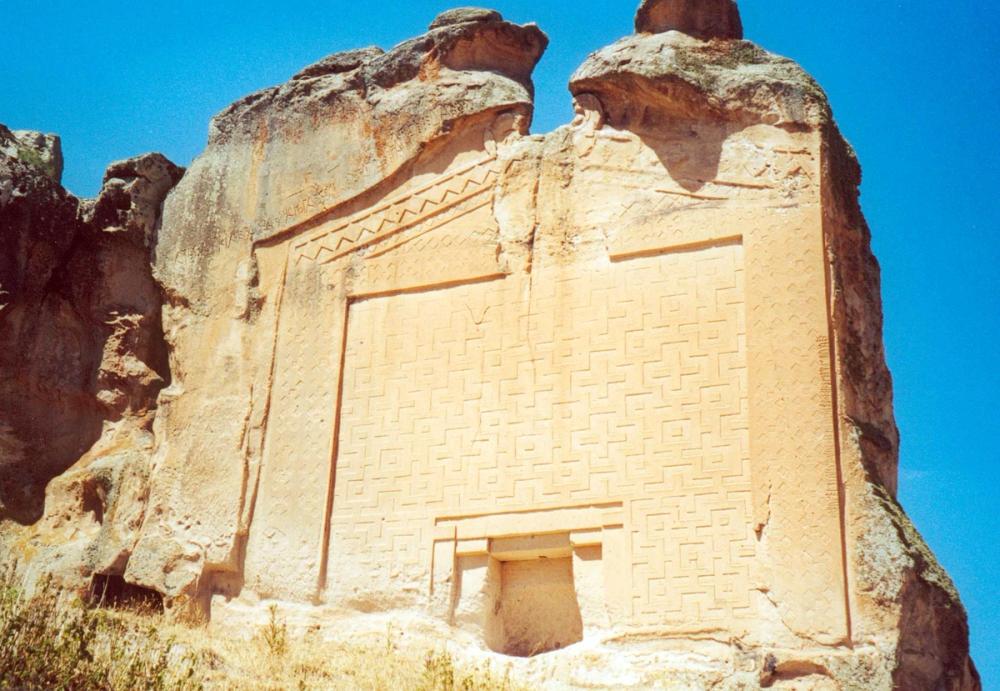
Further west, at Yazılıkaya in Eskişehir, the rock-cut facade called the Midas Monument carries a Phrygian inscription with his name.
 Myson · Wikimedia Commons (Public domain)
 Unknown author · Wikimedia Commons (CC BY-SA 3.0)
 Diego Velázquez · Wikimedia Commons (Public domain)
 Jusepe de Ribera · Wikimedia Commons (Public domain)